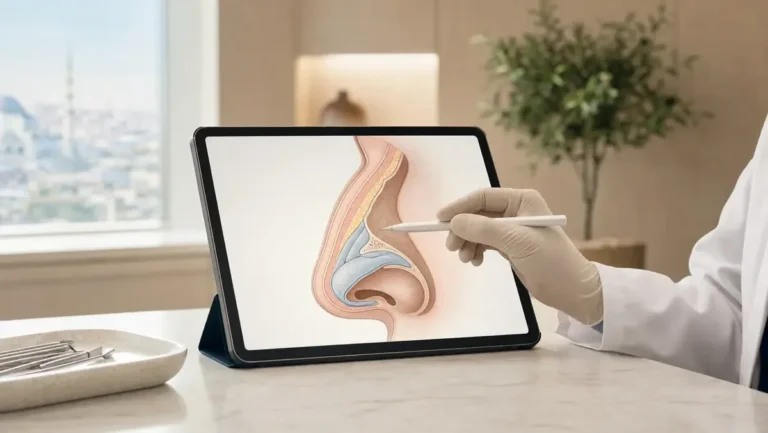

Skin thickness can influence how the framework of the nose becomes visible after rhinoplasty. Questions about thick skin rhinoplasty often concern tip definition and swelling, but the answer depends on the whole anatomy. Cartilage and bone form the underlying structure, while skin and soft tissue drape over it. A similar structural change may therefore look different beneath different soft-tissue envelopes. Thin skin can reveal subtle contours and small irregularities more readily; thicker skin may soften fine definition and, in some people, be associated with swelling that settles more slowly. Neither type automatically produces a good or poor result. Skin is one factor in an individual assessment, alongside anatomy, breathing, healing and goals.
What do surgeons mean by thick or thin nasal skin?
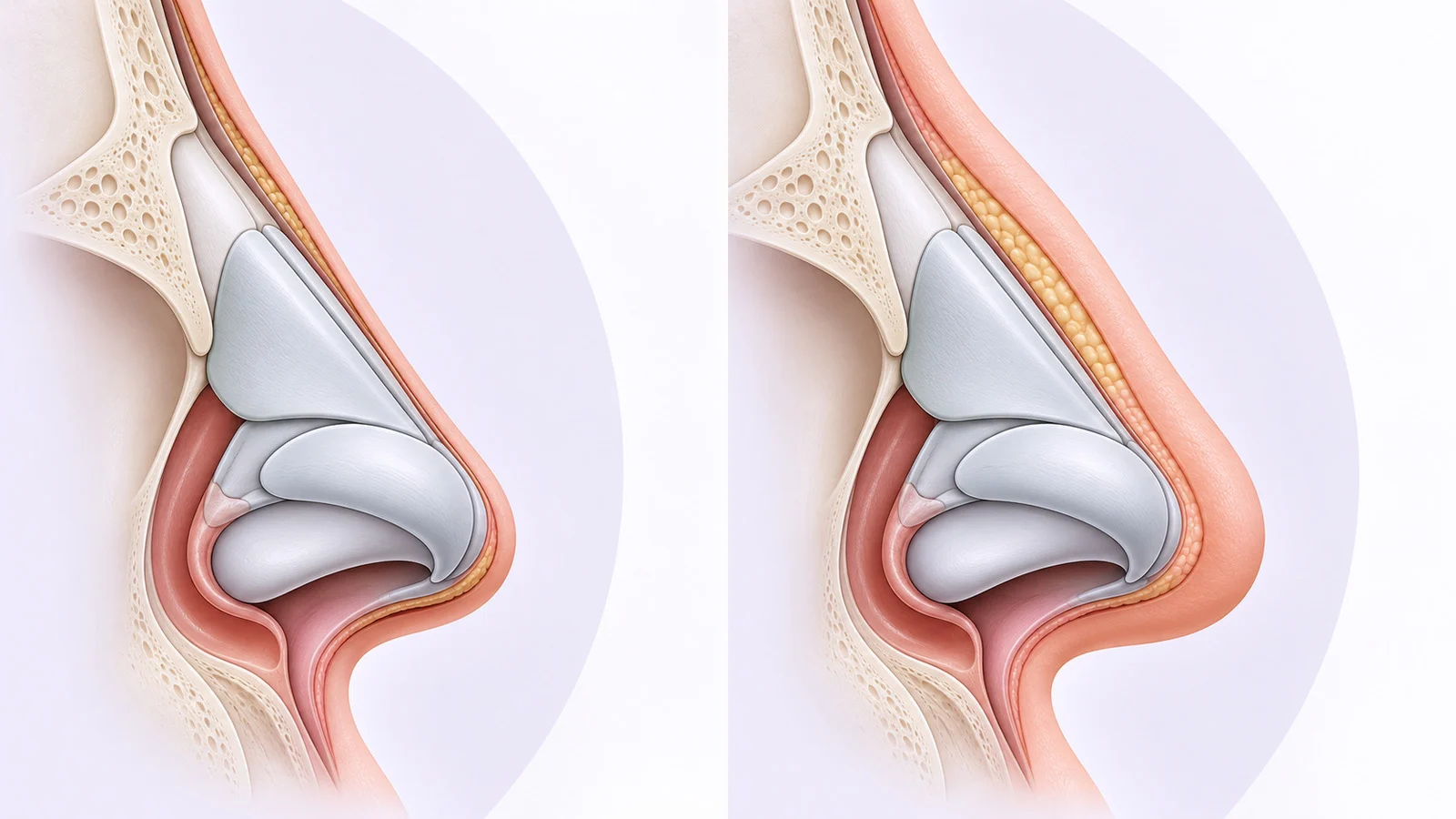
In everyday language, people often say “skin,” but clinicians may assess the broader skin-soft-tissue envelope. It includes the skin layers and tissue beneath them, and its thickness varies across the nose. The bridge, tip and sidewalls do not necessarily have the same covering. A nose can also have mixed characteristics rather than fitting neatly into one label.
For that reason, “thick” and “thin” are not universal measurements that can be assigned reliably from a selfie. A surgeon considers appearance and feel, skin quality and oiliness, visibility of the underlying framework, cartilage and bone, and the person’s history. Research has also used ultrasound and imaging to measure thickness at defined points, but those methods are not automatically needed in routine care. In a study of 190 adults, soft-tissue thickness varied by nasal subsite, and expert clinical assessment was associated with measured thickness.
Fill out the consultation form or send a message on WhatsApp so we can determine the right path for your surgery or facial rejuvenation.
Request ConsultationHow thin skin may affect appearance
A thinner envelope can make the underlying framework and subtle changes more visible. After surgery, small surface irregularities or edges may be easier to see than they would be beneath a thicker covering. At the same time, refined changes can also become visible more readily. Both sides of this trade-off matter in planning.
Thin skin does not guarantee a sharper, more attractive or flawless result. Cartilage support, natural asymmetry, healing, surgical planning and realistic goals all matter. A photograph or computer simulation cannot prove that another person’s skin, framework and healing pattern match yours. At consultation, it is more useful to ask what degree of definition may be realistic for your anatomy than to expect a specific outcome from the label “thin skin.”
How thicker skin may affect appearance
A thicker skin-soft-tissue envelope can make small changes in the underlying framework less apparent. In some cases, creating visible tip definition may be more challenging, and swelling may take longer to settle. These patterns are not identical for everyone. Thickness differs across nasal areas, while oiliness, previous surgery, tissue quality and individual healing can also affect the appearance.
Thicker skin alone does not rule out rhinoplasty or mean the result will be poor. Planning needs to account for the framework, soft tissue, breathing and facial balance together. Aggressively thinning the envelope simply to make the tip narrower can raise concerns about blood supply and healing. Any approach to the soft tissue is a specialist decision after examination, not a general or at-home recommendation.
Skin thickness and swelling
Swelling is part of healing after surgery, and its course varies from person to person. A thicker envelope may be associated with swelling that persists longer in some areas, but skin type cannot be used to promise a fixed recovery timeline. Even small studies show that swelling patterns differ by nasal subsite. For example, a study of 35 patients reported different changes at different nasal areas and follow-up times.
Daily comparisons with other people’s photographs, or judging the final result during the early months, are not reliable ways to assess healing. Follow-up should be planned with the treating surgeon, whose instructions take priority over general online timelines.
How does skin enter surgical planning?
Skin is only one part of assessment. A surgeon also evaluates facial proportions, cartilage shape and strength, bone, the airway, skin quality, prior injury or surgery, and the person’s goals. The discussion should cover which changes may be visible, where the anatomy creates limits, and how breathing and structural support are considered.
This is why another person’s result cannot serve as a plan that can simply be copied. For a broader overview of first-time surgery assessment, read Who Is a Good Candidate for Primary Rhinoplasty?. The access route is a separate question. For discussion of tissue changes after prior surgery, see Why Is Revision Rhinoplasty More Complex?.
Can you identify your skin type yourself?
Visible pores, shine or the visibility of contours may prompt useful questions, but they cannot diagnose skin thickness or predict a result. Lighting, make-up, camera angle and temporary swelling can change how the nose appears. Pinching or pulling the skin at home is not a substitute for examination. Skin type should not be inferred from ethnicity, sex or the shape of the nasal tip alone; individual variation is substantial.
At consultation, consider asking: Which areas of my skin-soft-tissue envelope are relatively thinner or thicker? How might that affect visible definition or swelling? What goals are realistic for my anatomy? Are there breathing or structural issues to evaluate? Do my medical history or medications affect timing or planning? Answers should follow an examination and a review of relevant health information.
Setting realistic expectations
Thin skin may show detail more clearly, while thicker skin may soften it; this is a general comparison, not a certain prediction. Rhinoplasty does not change skin in isolation or remove every natural difference. The purpose of discussion is to understand which changes may fit a person’s anatomy and which limits should be accepted.
Ask the surgeon to explain possible benefits as well as limits and risks. Medicines or supportive treatments before or after surgery should be used only when prescribed or recommended for your individual situation by the care team. This article does not recommend medication or home treatment to change skin thickness.
Frequently asked questions
Does thick skin mean rhinoplasty will have a poor result?
No. Skin thickness is one planning factor. Anatomy, nasal support, breathing, healing and realistic goals all matter, and no single feature can predict an individual result.
Does thin skin always create more precise results?
Not necessarily. Thin skin may reveal subtle changes, but it can also show small framework irregularities more clearly. It does not guarantee a particular shape or level of satisfaction.
Can skin type tell me how long swelling will last?
No. The skin-soft-tissue envelope may influence healing, but timing varies with the person and the areas treated. The treating surgeon should guide follow-up and assessment.
Can a selfie show whether my nasal skin is thick?
A selfie is not enough for diagnosis. Lighting, filters, angle and camera quality can change appearance, and assessment requires examination of the nose and its framework.
Summary
The main differences between thicker and thinner nasal skin relate to how the framework is covered, how visible fine details may be, and whether swelling may follow a different course. Neither type alone determines candidacy or guarantees a particular result. A personal assessment of skin, cartilage, bone, breathing and expectations supports an informed discussion.
This article is for general education and does not replace an examination, diagnosis or individualized medical advice. Decisions about procedures or care should be made after a clinician reviews your circumstances.
Scientific references
• Dey JK et al. Assessing Nasal Soft-Tissue Envelope Thickness for Rhinoplasty. JAMA Facial Plastic Surgery, 2019. Research article
• Erdur ZB et al. Effect of Nasal Soft-Tissue Envelope Thickness on Postoperative Healing Process Following Rhinoplasty. Journal of Craniofacial Surgery, 2021. Research article
• Kosins AM, Obagi ZE. Managing the Difficult Soft Tissue Envelope in Facial and Rhinoplasty Surgery. Aesthetic Surgery Journal, 2017. Research article