
“Fleshy nose” is a common search phrase, not a precise medical diagnosis. People may use it to describe a rounded tip, thicker skin, a broad nasal base or a combination of features. Two noses that look similar in a selfie can have different skin, cartilage, bone, breathing anatomy and facial proportions.
Realistic planning begins by identifying what creates the appearance of width and what can be changed safely. It does not mean promising a very small nose, a perfectly sharp tip or a copy of someone else’s result. A careful assessment also explains the limits of surgery and the time needed for swelling to settle.
Request an initial assessment on WhatsApp
Fill out the consultation form or send a message on WhatsApp so we can determine the right path for your surgery or facial rejuvenation.
Request ConsultationWhat does “bulbous,” “fleshy” or “wide” mean?
People may call a nose “fleshy” when its tip looks rounded or less defined, when the skin and soft-tissue envelope seems thick, or when the nostril wings look prominent. “Wide” may refer to the bony bridge, the tip, the distance between the nostrils, or the nose’s overall relationship to the face. These descriptions do not identify a single operation.
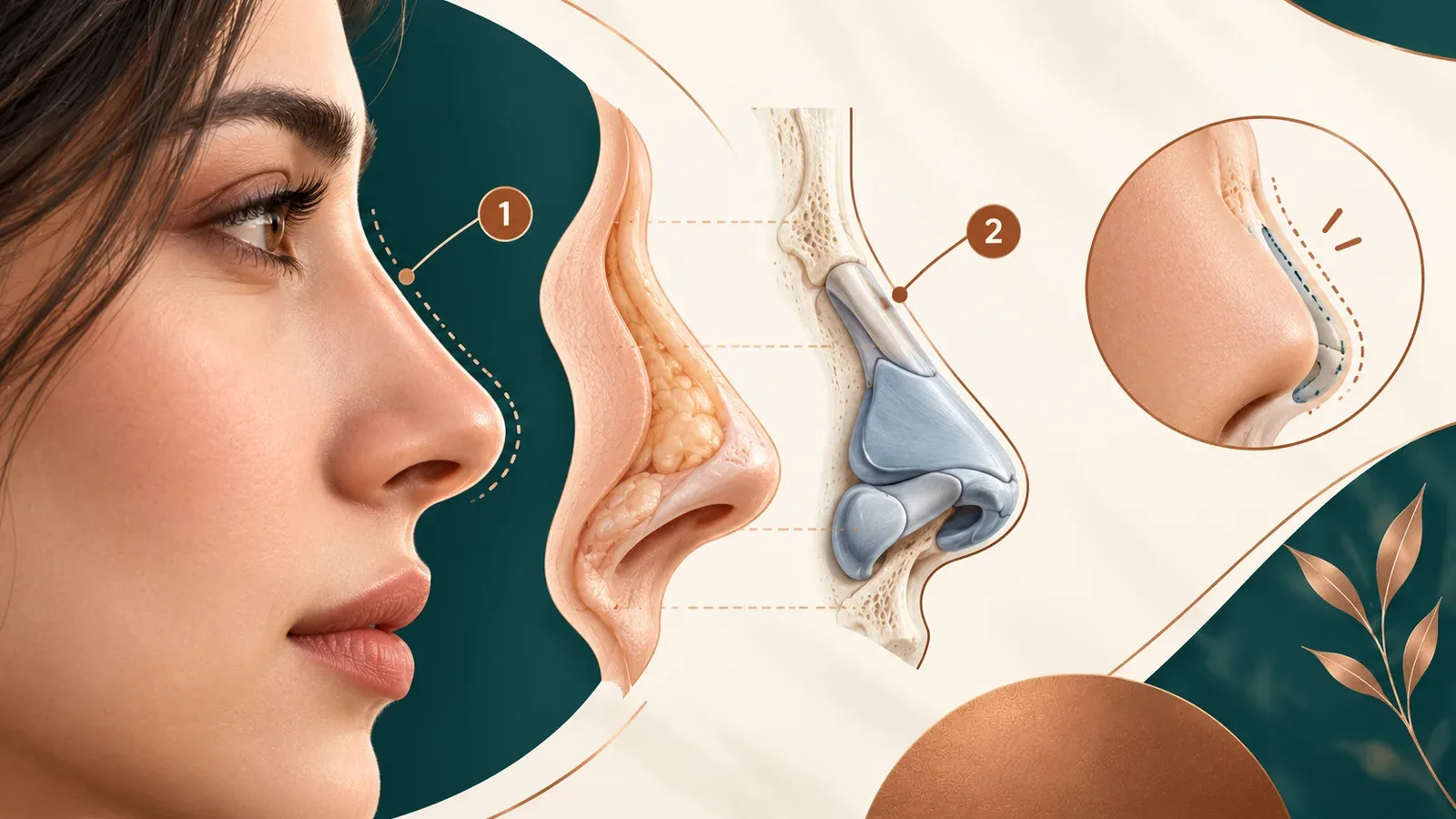
The visible shape comes from several connected structures: the upper nasal bones, the cartilage that supports the tip and sides, the skin-soft-tissue envelope, the nasal base and the airway. A rounded tip is not always caused only by thick skin; cartilage shape and support may also contribute. Likewise, a broad base is not the same concern as a wide bony bridge.
A close selfie or one frontal photograph cannot establish which structure is responsible. Camera distance, lens distortion, lighting and facial expression can change how wide or large the nose appears. In-person examination and standard views help separate the concern a person sees from the anatomy that needs to be assessed. Dr. Rastkari’s rhinoplasty services in Istanbul and Tehran describe the broader evaluation process.
Why can thicker skin make planning more demanding?
The skin and soft tissue form an envelope over the cartilage and bone. When this envelope is thicker or less elastic, fine changes in the underlying framework may be less visible, and postoperative swelling can take longer to settle. Rhinoplasty is therefore not simply a matter of removing cartilage or making the nose smaller. The supporting framework must be considered together with the tissue that covers it.
Thicker skin does not make improvement impossible or automatically mean someone is unsuitable for surgery. It also does not allow a surgeon to promise that the skin itself will become thin, that every tip will look sharply defined, or that a result will match a reference photo. Skin quality, bone and cartilage, breathing, previous surgery, healing and the person’s goals all matter. Reviews of thick-skinned rhinoplasty emphasize an individualized plan that considers both the soft-tissue envelope and the underlying framework.
What can make a nose look broad?
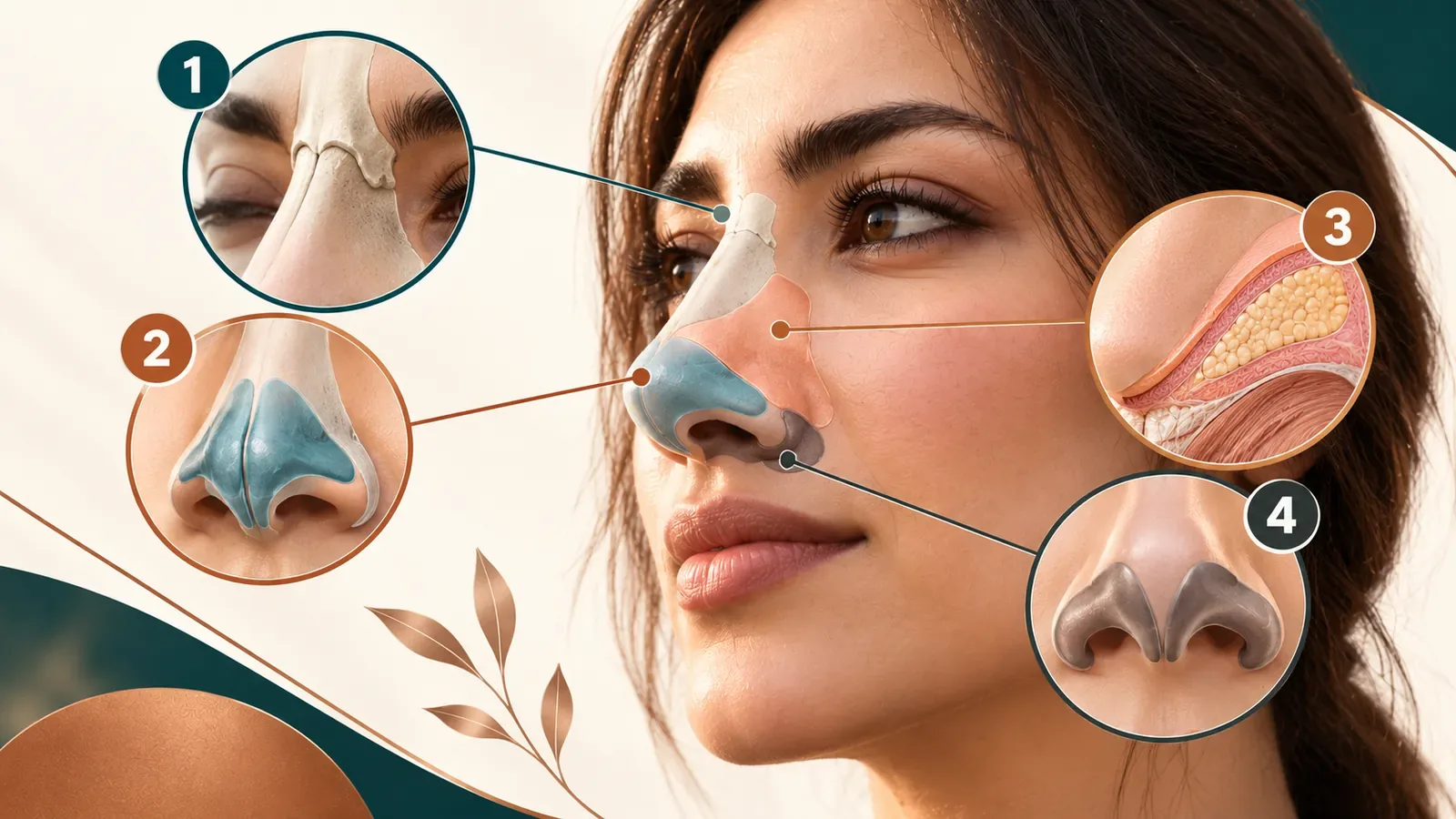
Width of the upper bridge
The width of the nasal bones can influence the frontal view. Any change needs to be considered alongside the bridge line, facial width and the transition into the tip. Narrowing one area without considering the rest of the face may not create a balanced result.
Tip shape and cartilage support
A rounded or less-defined tip can reflect skin thickness, cartilage shape, cartilage strength or a combination. If support is limited, removing too much structure may affect the shape or function. Cartilage grafting may be discussed when additional support or shaping is needed, but a graft is not required for every patient. Its source and role depend on the examination and surgical plan.
Nasal base and nostril wings
Prominent nostril wings or a wide nasal base can contribute to a broad frontal appearance. Base modification is not an automatic step in every rhinoplasty. If it remains appropriate after the rest of the nose has been assessed, the surgeon can explain the options, possible scars and risks such as asymmetry or narrowing of the nostril opening. A wish for “smaller nostrils” alone does not determine whether surgery is suitable.
The educational map below separates these features. One or several may contribute in an individual nose.
What approaches may be discussed in thick-skinned rhinoplasty?
The plan depends on the source of the concern and on realistic goals. A surgeon may discuss reshaping the bony framework, supporting or refining cartilage, careful management of the soft-tissue envelope, or selected changes to the nasal base. These are general options, not a checklist that every patient should receive.
Aggressive removal of soft tissue or “thinning the skin” is not a universal solution. Disproportionate tissue removal can put skin circulation, surface smoothness, healing or the final appearance at risk. Grafts are not simply tools for narrowing the nose either; in selected cases, they may help support or shape the framework. The right decision depends on examination, breathing, medical history and the surgeon’s judgment.
A more useful consultation question is not “Which technique is best for a fleshy nose?” but “Which structures are contributing to my concern, what change is reasonable, and what are the benefits and limits of each option?”
What is a realistic result?
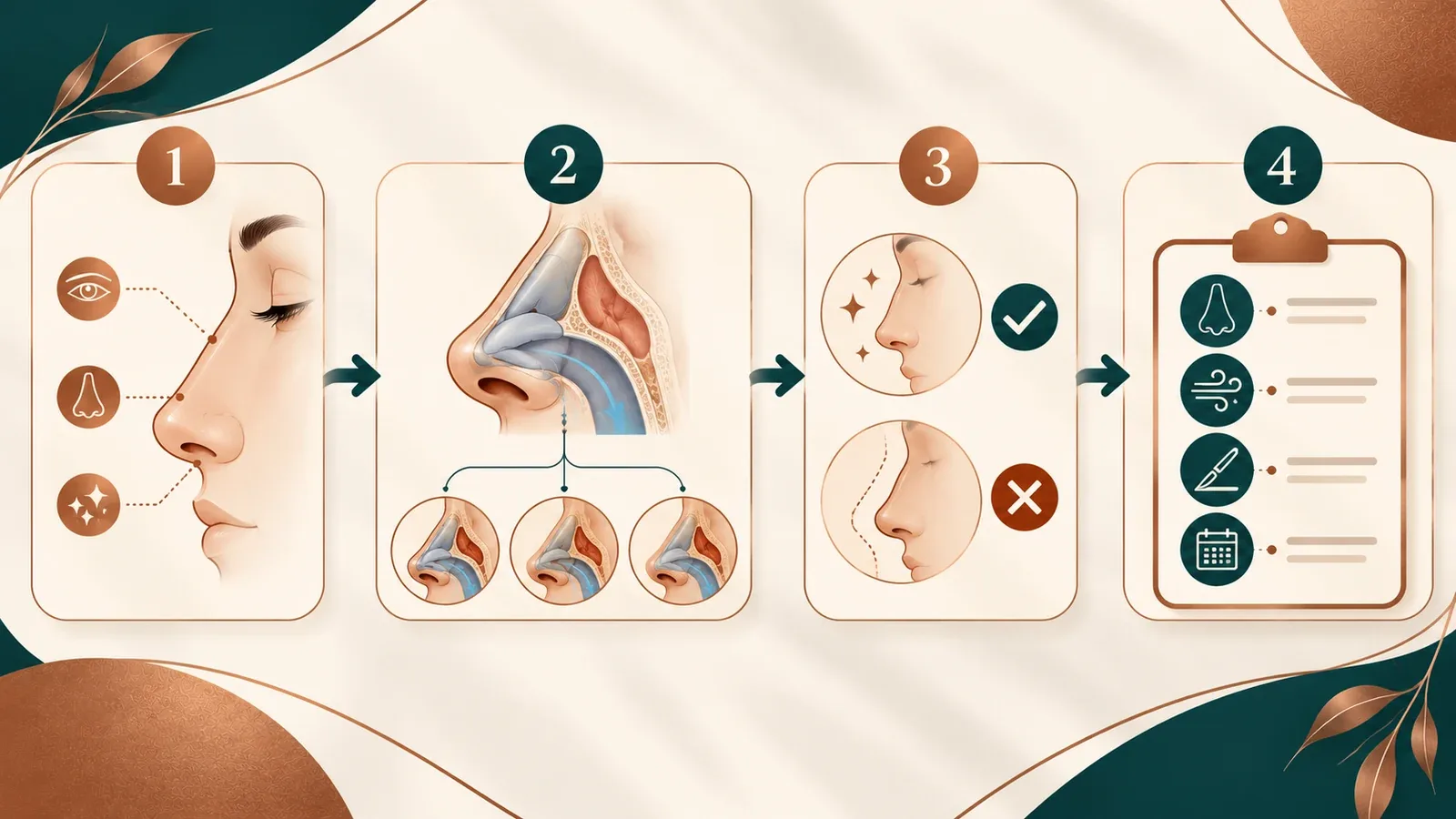
A reasonable goal may be better proportion or more definition in selected areas—not an extremely small nose or the complete removal of every natural difference. A shape that suits one face may not suit another person’s forehead, lips, chin, skin or airway. Preserving some width and volume can sometimes be more balanced than narrowing the nose as much as possible.
Discuss both the frontal and profile views. Ask which feature may improve, which changes have limits, whether breathing is part of the plan and what complications are possible. If computer imaging is offered, treat it as a communication aid, not a guarantee of the result.
Before-and-after photographs show other people’s outcomes. For a fair comparison, the view, lighting, camera distance, facial expression and healing stage should be similar. One selected image or social-media video cannot predict your skin characteristics, internal structure or result.
For a broader review of candidacy and expectations, see the primary rhinoplasty candidacy guide.
When does swelling in a thick-skinned nose settle?
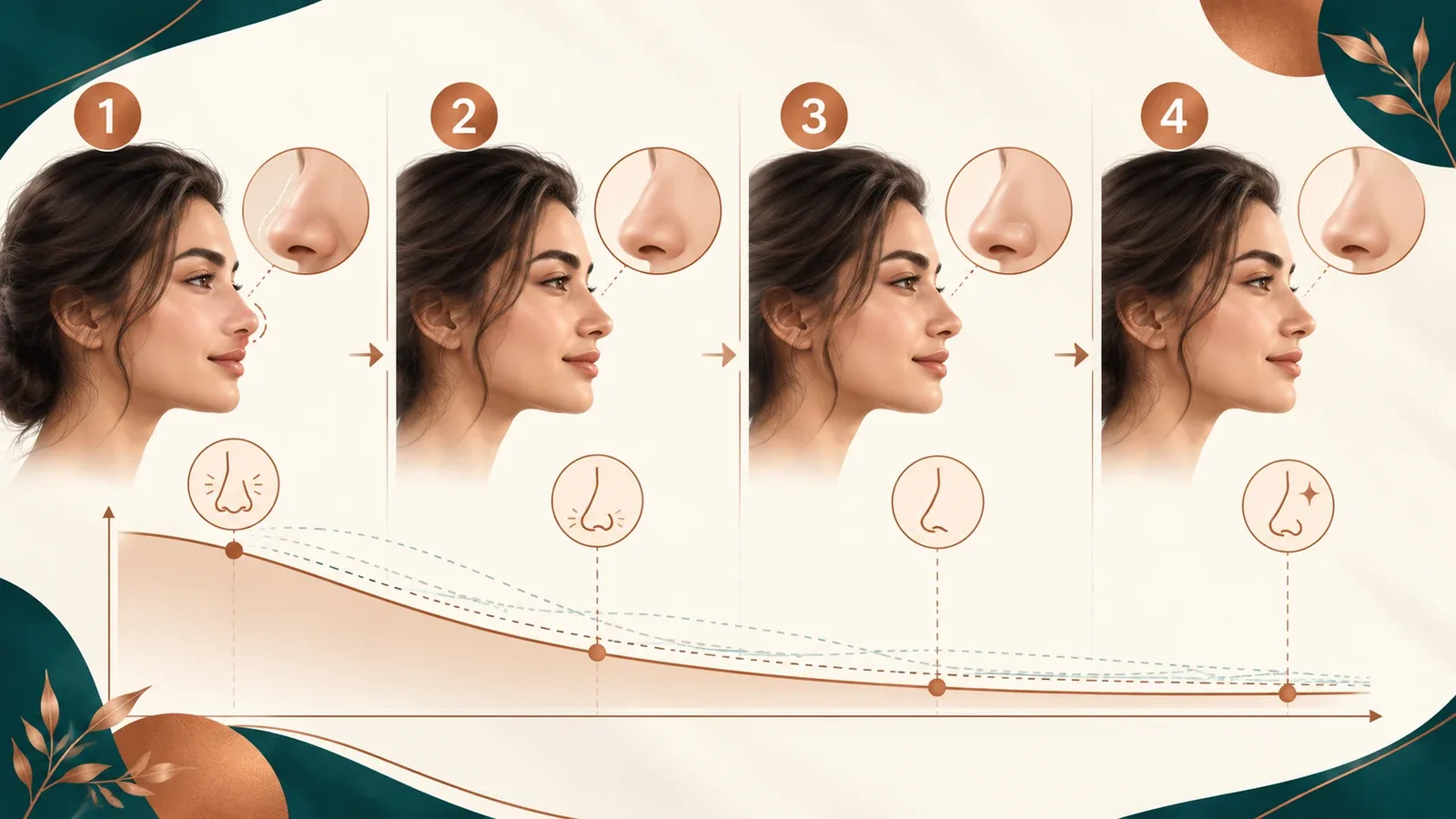
Visible bruising and swelling change during the first weeks, but the nose is not finished healing at that point. Early swelling often subsides over several weeks, while small changes in the tip and contour can continue over months. The American Society of Plastic Surgeons notes that the contour may take up to a year to refine. A thicker soft-tissue envelope is associated with prolonged swelling, so some people may continue to see subtle changes beyond a year, especially at the tip. Twelve to eighteen months is not a fixed deadline or a guaranteed timeline for everyone.
Swelling can fluctuate during recovery, and a photograph from one day does not show the final result. Scheduled follow-up and consistent photographs requested by the clinical team are more useful than judging the nose too early.
Read the general rhinoplasty recovery timeline.
How should aftercare be handled?
Instructions depend on the operation and the individual. Do not copy another patient’s taping, massage, compress, washing routine, medicines, injections or return-to-exercise schedule. These steps should follow the operating team’s plan; medicines or injections intended to address swelling require a clinician’s decision.
Ask the team for a clear written plan for visits, nasal protection, daily activity and who to contact if something concerns you. If you develop increasing pain, significant bleeding, fever, new breathing difficulty or another worrying symptom, contact the clinical team or local emergency service. An online article or photograph cannot diagnose a complication.
What affects the cost of rhinoplasty in Istanbul?
The estimate may vary with whether surgery is primary or revision, the complexity of the anatomy, functional needs, the facility, anaesthesia and the follow-up plan. If a travel service is offered, ask which costs are actually included—for example, hospital care, pre- and postoperative assessments, accommodation, transport or an interpreter. The word “package” should not be taken to mean every item is automatically covered.
Without a current, confirmed price, a figure or “starting from” amount should not be guessed. Ask for a written, dated estimate that lists what is included, what is billed separately, how follow-up is arranged and what happens if the plan changes.
Ask about assessment and a cost estimate in Istanbul on WhatsApp
Questions to ask at consultation
• Which feature contributes most to the width I see: bone, cartilage, skin and soft tissue, or the nasal base?
• Could a breathing concern or previous surgery affect the plan?
• What change is realistic in the frontal and profile views, and what may remain?
• Are a cartilage graft or base modification being considered for my anatomy? Why, and what are the limits and risks?
• How will swelling and progress be assessed over the following months?
• Exactly which services are included in the written estimate?
Summary
“Fleshy nose” does not describe one uniform anatomy or one standard procedure. Skin thickness, cartilage and bone, the nasal base, breathing and facial proportions all influence the appearance and the plan. A realistic result starts with identifying those factors, choosing proportionate changes and allowing time for healing—not with a promise of a particular shape.
This article is for general education and does not replace an examination, diagnosis or personal medical advice. Decisions about surgery and aftercare should be made with a clinician who has assessed the individual situation.
Frequently asked questions
Does thick skin mean rhinoplasty will not work?
No. Skin thickness can affect how clearly details show and how long swelling lasts, but it does not determine the outcome by itself. Cartilage and bone, breathing, goals and individual healing also matter.
Can surgery make the skin on my nose thinner?
Rhinoplasty does not necessarily thin the skin. Planning must account for the soft-tissue envelope, and any skin-specific treatment should only be considered after a clinician’s assessment.
Can swelling in a fleshy nose last 12 to 18 months?
Some swelling settles over weeks, while tip definition and subtle contour changes may continue for months and sometimes beyond a year. Twelve to eighteen months is not the same for everyone and is not a guaranteed finish date.
Does every thick-skinned nose need a cartilage graft?
No. A graft is considered only when the framework needs support or shaping. The decision depends on the anatomy, functional needs and the findings of an examination.
Are the nostrils always made smaller during rhinoplasty?
No. Nasal-base modification is not needed or appropriate for everyone. The surgeon assesses the base, nostril shape, facial balance and possible effect on the nostril opening.
How much does rhinoplasty cost in Istanbul?
There is no single figure that applies to every case. The plan, facility, anaesthesia and any included services can affect the estimate. Compare only current written quotes that list included and excluded items.
Medical sources used
• American Society of Plastic Surgeons — Rhinoplasty Recovery
• Vahidi et al. — Rhinoplasty for Thick-Skinned Noses: A Systematic Review, 2023
• Cobo et al. — Management of Thick Skin in Rhinoplasty, 2024
• Muluk — Optimizing Outcomes in Thick-Skinned Rhinoplasty, 2026
• Rohrich et al. — Alar Base Reduction: Nuances and Techniques
Author and review
Dr. Masoud Rastkari is an ENT Specialist and Facial Aesthetic Surgeon with more than 23 years of professional experience. This draft is prepared for the doctor’s final review; it must not be described as medically reviewed until that review is complete.